Do I need to reinspect asbestos in my hotel?
Open almost any asbestos management survey report and you'll find the same recommendation: "Reinspect in 12 months." It's become so common that many dutyholders assume it's a legal requirement. It isn't. UK asbestos legislation does not require annual reinspection of asbestos-containing materials in situ.
Why does my survey recommend annual inspections?
To answer that, we need to separate legal requirements from industry practice. While many asbestos management survey’s recommend annual reinspection, the Control of Asbestos Regulations 2012 do not prescribe a fixed inspection frequency.
Everything begins with Regulation 4, the Duty to Manage. It requires dutyholders to identify asbestos-containing materials, maintain an up to date asbestos register, monitor the condition of asbestos-containing materials, and review their asbestos management arrangements regularly.
What Regulation 4 does not do is specify how often those inspections should take place. There is no requirement for inspections every six months, every 12 months, or at any other fixed interval. Instead, the legislation takes a risk-based approach: asbestos must be monitored appropriately, with inspection frequencies determined by the likelihood of disturbance, the condition of the material, and how the building is used.
So, if the law doesn't require annual reinspection, why do so many asbestos survey reports recommend it? To answer that, we need to look beyond the legislation and examine the guidance documents that have shaped industry practice. To understand this, we need to look at what the key asbestos documents actually say and, more importantly, who they were written for.
L143 Managing and Working with Asbestos (Approved Code of Practice)
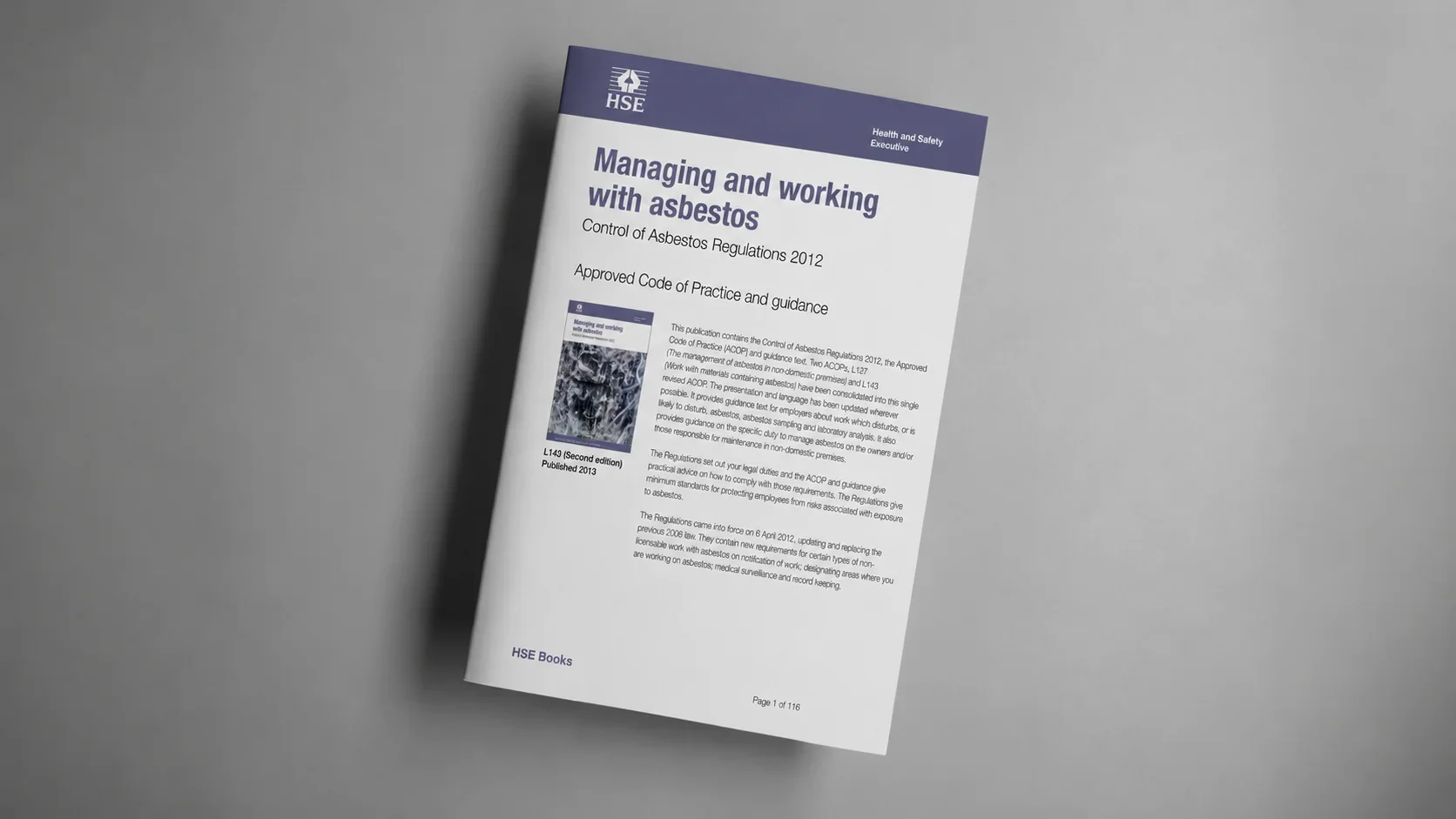
Official HSE publication: Managing and working with asbestos: Control of Asbestos Regulations 2012 Approved Code of Practice and Guidance (L143, Second Edition, 2013).
What is L143?
L143 is the Approved Code of Practice (ACOP) supporting the Control of Asbestos Regulations 2012. Published by the Health and Safety Executive (HSE), it explains how dutyholders and employers can meet their legal obligations when managing and working with asbestos.
Who wrote L143?
The document was produced by the HSE and carries greater authority than general guidance because it is an Approved Code of Practice. While following an ACOP isn't compulsory, courts may consider it when deciding whether legal duties have been met.
Who is L143 written for?
L143 is aimed at dutyholders, employers, building owners, facilities managers, maintenance teams and anyone responsible for managing or working with asbestos. It bridges the gap between the legislation itself and its practical application.
What does L143 say about inspection frequency?
Interestingly, very little.
L143 reinforces the need to monitor asbestos-containing materials, keep the asbestos register up to date and review asbestos management arrangements at suitable intervals. However, it deliberately avoids prescribing fixed inspection frequencies. There is no reference to inspections every six months, every 12 months or any other mandatory timescale.
How should dutyholders interpret L143?
L143 supports the same principle established by Regulation 4: inspection frequency should be determined by risk, not by a calendar. The document expects dutyholders to exercise judgement based on factors such as the condition of the asbestos, the likelihood of disturbance and how the building is used. It does not suggest that annual reinspection is the default approach.
HSG227 A comprehensive guide to Managing Asbestos in premises
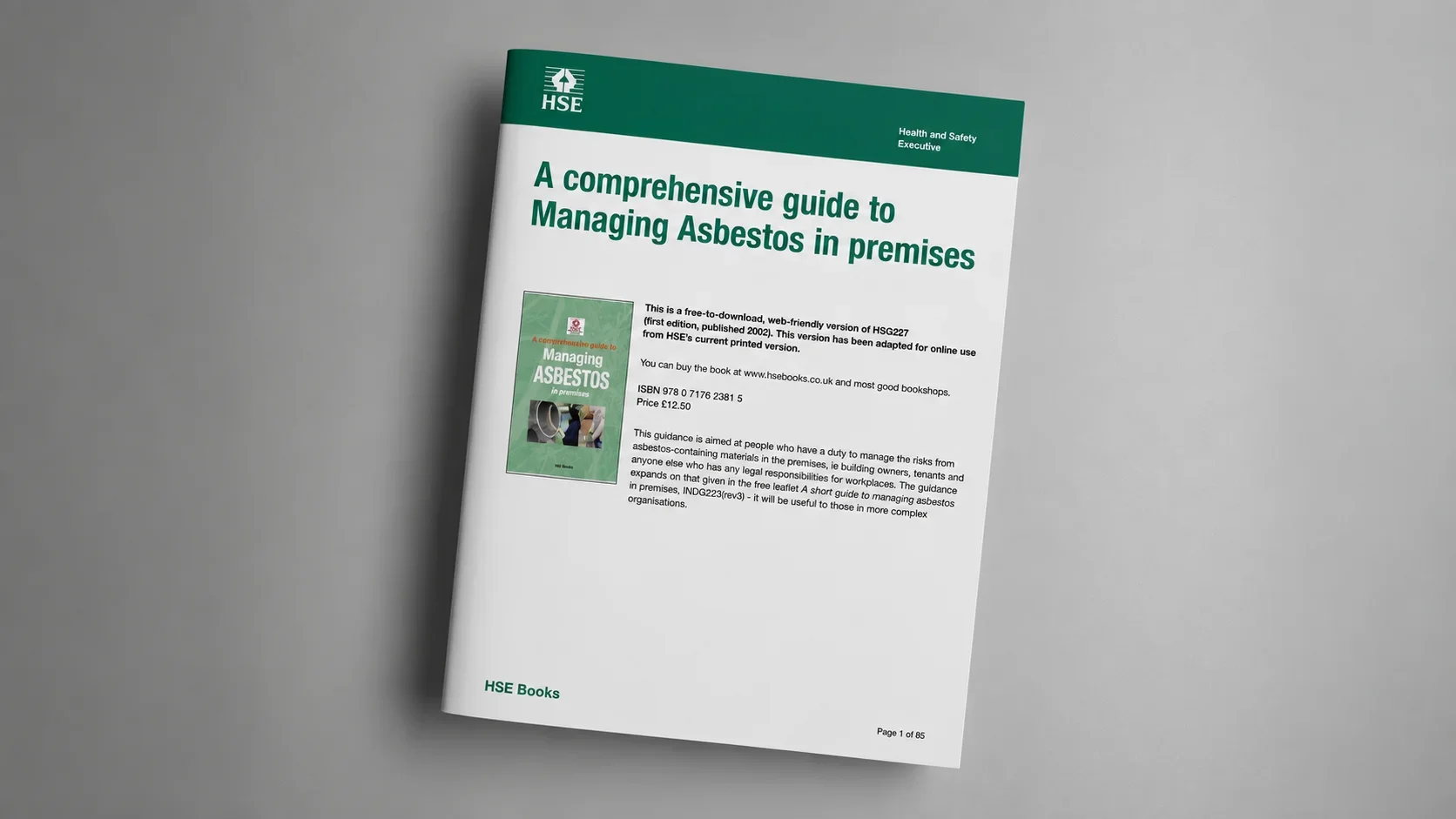
Official HSE publication: HSG227 A comprehensive guide to Managing Asbestos in premises.
What is HSG227?
HSG227 is a practical guide to managing asbestos in non-domestic premises. While the Control of Asbestos Regulations 2012 set out the legal duties, HSG227 explains how dutyholders can implement an effective asbestos management system in practice.
Who wrote HSG227?
The guide was published by the Health and Safety Executive (HSE) to help dutyholders develop proportionate asbestos management arrangements. Although it is guidance rather than legislation, it is widely recognised as the benchmark for good practice.
Who is HSG227 written for?
HSG227 is aimed at building owners, dutyholders, facilities managers, estates teams and anyone responsible for managing asbestos in occupied buildings. It focuses on the day-to-day management of asbestos rather than surveying or removal.
What does HSG227 say about inspection frequency?
HSG227 is the first document to discuss how often asbestos-containing materials should be inspected. Rather than prescribing a fixed inspection interval, it explains that inspection frequency should be determined by a range of risk factors, including:
The location of the ACM.
How accessible it is.
The level of building activity.
Occupancy and use of the area.
The likelihood of disturbance.
Changes in the building or its management.
The message is clear: not all asbestos-containing materials require the same inspection frequency.
How should dutyholders interpret HSG227?
HSG227 places inspection frequency firmly within the asbestos management plan, not the asbestos survey.
A survey records what was present and its condition on the day it was undertaken. The asbestos management plan then uses that information, together with knowledge of how the building operates, to determine an appropriate inspection regime.
This is an important distinction. Two identical asbestos-containing materials in different locations may require completely different inspection frequencies because the risk of disturbance, not simply the condition of the material, drives the management decision.
HSG264 Asbestos: The survey guide
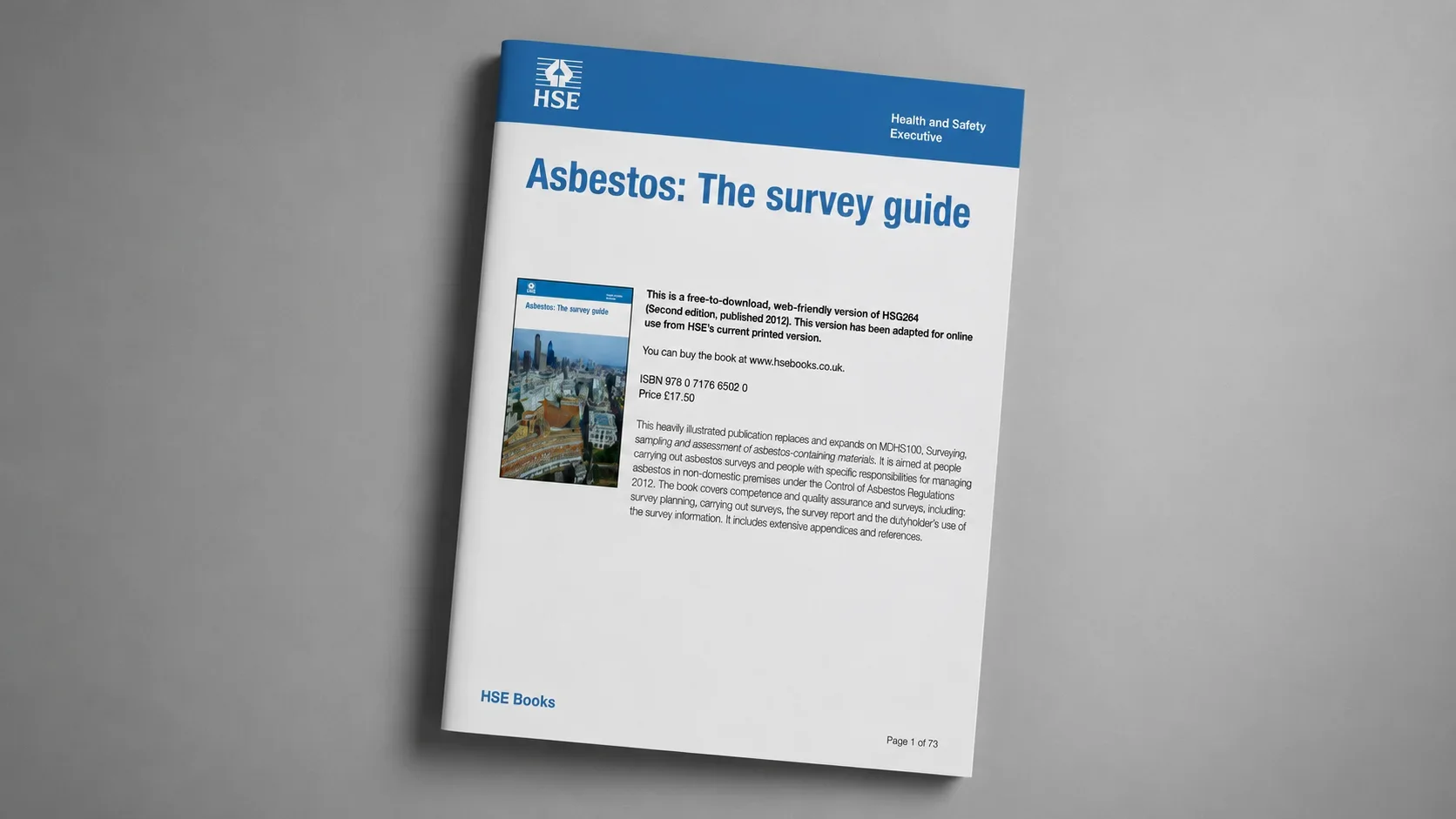
Official HSE publication: HSG264 Asbestos: The survey guide
What is HSG264?
HSG264 is the Health and Safety Executive's official guidance for carrying out asbestos surveys. It sets the standard for how asbestos surveys should be planned, undertaken and reported, ensuring surveyors produce consistent and reliable information for dutyholders.
Who wrote HSG264?
The guide was published by the Health and Safety Executive (HSE) and is recognised as the industry benchmark for asbestos surveying. It is the document that UKAS-accredited asbestos surveyors are expected to work in accordance with.
Who is HSG264 written for?
HSG264 is primarily written for asbestos surveyors and surveying organisations, but it is also relevant to dutyholders who commission surveys and need to understand what an asbestos survey can and cannot deliver.
What does HSG264 say about inspection frequency?
Interestingly, very little.
HSG264 explains how surveyors should identify asbestos-containing materials, assess their condition, collect representative samples where appropriate and produce an accurate survey report. It also introduces the material assessment, which evaluates the potential of an asbestos-containing material to release fibres if disturbed.
However, HSG264 does not instruct surveyors to determine future inspection frequencies or prescribe annual reinspection schedules. Its purpose is to provide accurate information about the presence, location and condition of asbestos, not to develop the building's asbestos management strategy.
How should dutyholders interpret HSG264?
This is one of the most misunderstood aspects of asbestos management. An asbestos survey is a snapshot in time. It records what was present and the condition of the asbestos on the day of the inspection. It does not take account of future building use, maintenance activities, occupancy patterns or organisational change, all of which influence how often asbestos should be inspected.
Those decisions belong within the asbestos management plan, where the survey findings are combined with operational knowledge and risk assessment. The survey informs the asbestos management plan; it does not replace it.
INDG223 Managing asbestos in buildings.
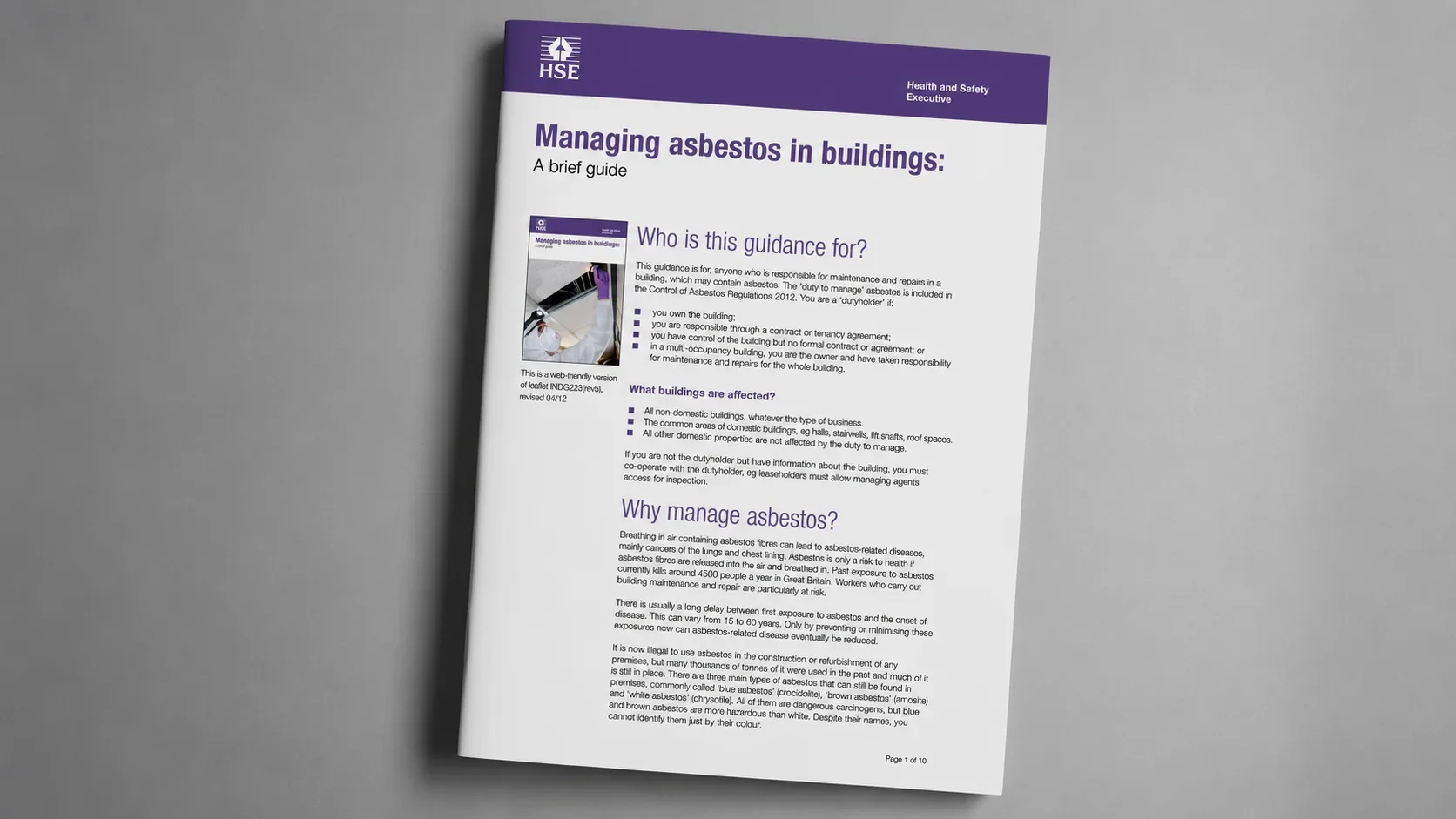
Official HSE publication: INDG223 Managing asbestos in buildings.
What is INDG223?
INDG223 is a short HSE guidance leaflet written for non specialist dutyholders beginning to manage asbestos. Unlike L143, HSG227 and HSG264, it isn't a technical guidance document. Instead, it provides simple, practical advice to help dutyholders understand their responsibilities.
Who wrote INDG223?
INDG223 was produced by the Health and Safety Executive (HSE) as an introductory guide to asbestos management. It is intended to help dutyholders establish effective management arrangements, rather than define technical surveying standards.
Who is INDG223 written for?
The leaflet is aimed at building owners, landlords, facilities managers and other dutyholders who may have little or no prior experience of managing asbestos. It explains the key principles in a clear and accessible way.
What does INDG223 say about inspection frequency?
Unlike the previous documents, INDG223 does provide an example of inspection frequency. It explains that asbestos-containing materials are typically inspected every 6 to 12 months, depending on:
the type of material;
its location; and
its condition.
Importantly, this is presented as practical guidance to help dutyholders establish an inspection regime. It is not a statutory requirement or a prescribed inspection interval.
How should dutyholders interpret INDG223?
Read in isolation, it's easy to see how the phrase "typically every 6–12 months" could be interpreted as a standard recommendation.
However, when read alongside the Control of Asbestos Regulations 2012, L143, HSG227 and HSG264, a different picture emerges. The legislation requires asbestos to be monitored, the ACOP requires arrangements to be suitable, HSG227 explains that inspection frequency should be risk-based, and HSG264 makes clear that surveys provide information rather than management decisions.
INDG223 does not contradict those documents. It simply provides a practical example for dutyholders who are beginning to develop an asbestos management plan.
Why do survey reports default to annual inspections?
In many cases, surveyors include annual reinspection recommendations as a cautious starting point for dutyholders. However, taken together, the UK's principal asbestos guidance documents present a consistent, risk-based approach to asbestos inspections:
Control of Asbestos Regulations 2012
✔ Requires asbestos-containing materials to be monitored and kept under review.
✖ Does not prescribe annual inspections.
L143 – Managing and Working with Asbestos
✔ Monitoring arrangements should be suitable and proportionate to risk.
✖ Does not specify inspection intervals.
HSG227 – A Comprehensive Guide to Managing Asbestos in Premises
✔ Inspection frequency should be based on risk factors such as location, occupancy and likelihood of disturbance.
✖ Does not recommend annual inspections for all ACMs.
HSG264 – Asbestos: The Survey Guide
✔ Explains how asbestos surveys should be carried out.
✖ Does not instruct surveyors to set inspection frequencies.
INDG223 – Managing Asbestos in Buildings
✔ Suggests inspections are typically every 6–12 months, depending on the material, location and condition.
✖ Does not make this a legal or mandatory requirement.
There is no contradiction between these publications.
The confusion arises when illustrative guidance intended to help dutyholders is treated as a universal surveying instruction. Once a typical example becomes a standard recommendation inside a survey report, the distinction between guidance and requirement can easily become blurred.
In practice, survey organisations often adopt fixed recommendations because they:
simplify reporting templates,
satisfy audit expectations,
reduce professional liability,
and meet client expectations for certainty.
Annual inspection becomes a defensible default, even where risk does not justify it. But compliance achieved through uniformity is not the same as compliance achieved through management.
Effective asbestos management depends on clear separation of responsibilities. The survey provides material information about asbestos-containing materials and their condition. Priority assessment then considers how those materials relate to building use and operational activity.
Decisions regarding inspection frequency sit with the dutyholder, forming part of the asbestos management arrangements. Ongoing control is maintained through the management system, ensuring risks continue to be reviewed and managed as circumstances change.
When these roles are respected, inspection frequencies naturally vary, as they should. Some materials may justify quarterly review. Others may remain stable for years. Both approaches can be fully compliant.
Asbestos compliance is not a calendar exercise
The safest buildings are not those inspected most often. They are the ones managed intelligently.
Asbestos compliance was never intended to be template driven. It was designed to be risk-led, informed, and actively managed. Sometimes, the most compliant decision is not to follow the default wording in the report, but to understand where that wording came from in the first place and challenge it.
The wider implications of this practice are explored further here: Are Annual Asbestos Inspections Mandatory for UK Hotels?
Learn more about asbestos compliance for hotels, or Speak with The KV Group for impartial advice.
Frequently Asked Questions
Are annual asbestos inspections a legal requirement?
No. The Control of Asbestos Regulations 2012 do not specify that asbestos-containing materials must be inspected every 12 months. The law requires asbestos to be monitored and managed effectively, but inspection frequency should be based on risk rather than a fixed timetable.
Why do so many asbestos survey reports recommend annual reinspection?
Many asbestos management survey reports include a recommendation to reinspect asbestos-containing materials every 12 months because this has become common industry practice. However, HSE guidance shows that inspection intervals should be determined by factors such as the material's condition, location, likelihood of disturbance and how the building is used.
Does an asbestos survey decide how often inspections should take place?
No. An asbestos management survey provides information about the presence, location and condition of asbestos-containing materials at the time of the survey. The inspection regime should then be determined through the asbestos management plan, taking into account how the building is occupied, maintained and managed.
What does the HSE recommend for asbestos inspection frequency?
The HSE does not prescribe a universal inspection interval. Its guidance consistently promotes a risk-based approach, with inspection frequency determined by the condition of the asbestos-containing material, its accessibility, the likelihood of disturbance and the building's operational use. While six to twelve months may be appropriate in some circumstances, it is not a legal requirement for every material or every building.
How should hotels determine their asbestos inspection frequency?
Hotels should base inspection frequency on their individual asbestos management plan. High-traffic areas, refurbishment works, frequent maintenance activities or vulnerable asbestos-containing materials may justify more frequent inspections, while stable materials in low-risk locations may require less frequent review. The key is ensuring the inspection programme is proportionate, documented and supported by a suitable asbestos risk assessment.